
Feed Conversion Ratio
“A what?”
A Feed Conversation Ratio. The FCR indicates how many kg feed is needed to obtain 1kg product. In other words, it’s the amount of food required to produce an outcome. Meat from beef, milk from dairy, eggs from poultry, and in our case meat from fish and seafood.
Nice to know but what does it mean?”
If you know that fish and seafood have a low Feed Conversion Ratio, it means they consume a relatively small volume of feed in order to reach the desired product yield and they are ready for production. Especially if you compare fish and seafood with cows and pigs. These protein sources consume a lot more, which automatically means that a shrimp pond is much less polluted with “shit” than a cow or pig farm.
“As long as (sh)it doesn’t end up on my plate..”
Completely agree, but less feed and thus less shit has so many benefits. To name a few:
- Less shit, means less contamination of the living area
- Lower production costs as you simply need to give less food
- It automatically leads to a lower carbon footprint, because:
Less feed = less production = less emission = better for the environment
Less feed = less transport = less emission = better for the environment
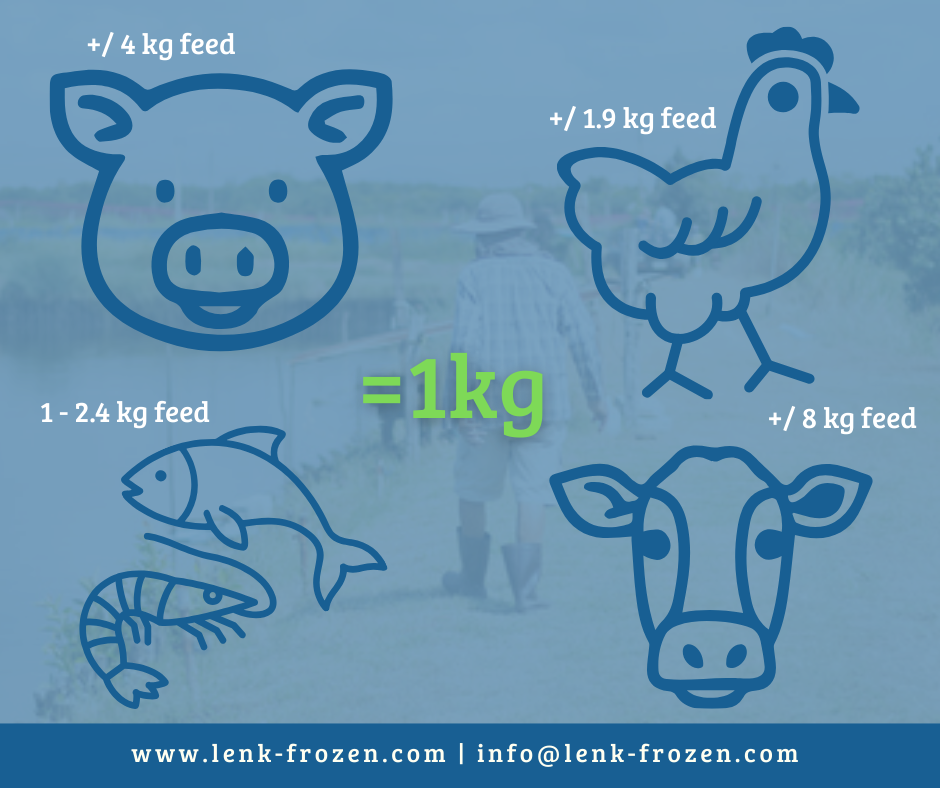
The number you see in the image is just an estimation. Even within a specific product group such as shrimp, the eventual Feed Conversion Rate depends on whether it concerns shrimps from intensive, semi-intensive or extensive aquaculture. In extensive aquaculture shrimps are not receiving any additional food which brings the ratio even lower.
In other words, consuming fish and seafood which usually have a lower Feed Conversion Ratio (compared to most other sources of protein), is good for both our health and the health of the environment.
For farmers it’s a challenge to prevent overfeeding and find the right balance so that it positively impacts the organisation.
For us, consumers, it’s another reason (besides the health benefits and the great taste) to choose more often farmed fish and seafood.
17.03.2026
REFERENCES:
- Fish Farm Feeder. FCR in aquaculture. https://www.fishfarmfeeder.com/en/fcr-in-aquaculture/
- Seafoodwatch. What’s the issue? https://www.seafoodwatch.org/seafood-basics/sustainable-solutions/consider-climate
- Hendrix Genetics. ‘SFCR’ Sustainable (Feed) Conversion Rate explained. https://www.hendrix-genetics.com/en/articles/sfcr-sustainable-feed-conversion-rate-sfcr-explained/